Your agent says the refund is processing. Can anyone prove it?
A consumer commission ordered Air India to pay a refund it had admitted it owed, because nothing showed it had been paid. One ticket, rewritten, to show what a support agent needs before saying "it's on its way".
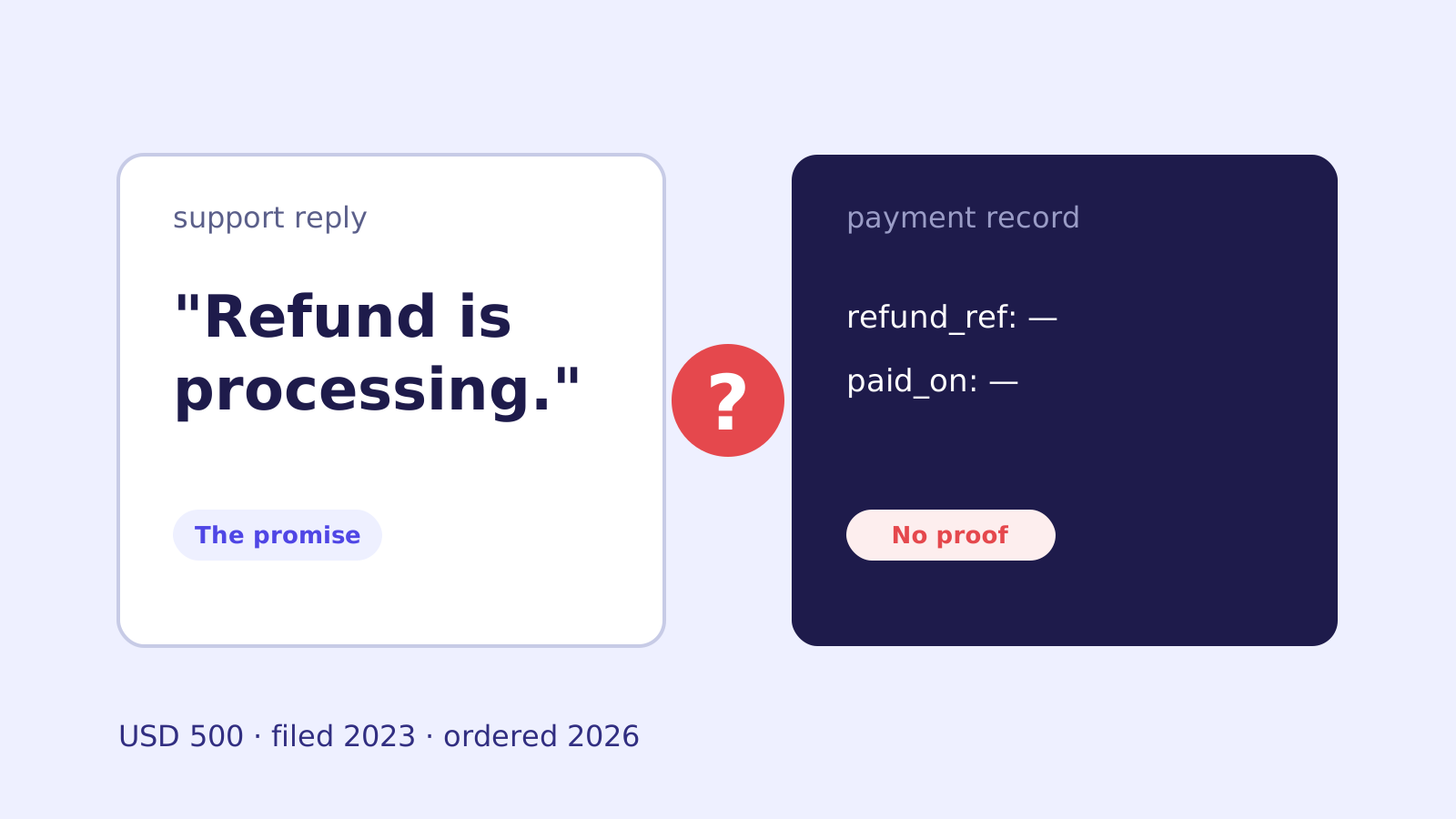
On 23 September 2026, a Chandigarh consumer commission ordered Air India to refund USD 500 (about Rs 31,440) to a passenger, with 9% interest from September 2023 and Rs 10,000 for harassment and costs1. The airline had never disputed that the money was owed. It said the refund was being made. The commission found no evidence that it ever was, and treated that gap as deficiency in service.
What actually went wrong in this ticket?
The passenger had paid an extra USD 500 to move a return flight. Air India accepted in the proceedings that the charge would go back to the original payment method without deduction. His grievance at the airline’s Chandigarh office was, by his account, never resolved. He filed in September 2023. The order came three years after that1.
The commission rejected his larger claim of USD 1,180, because he could not prove the ticket had been cancelled. So the airline was wrong about one thing and the customer about another. Nobody on either side could produce a record that settled it quickly.
That is the shape of a support failure that costs money: a statement (“it’s being refunded”) that no one can check against the rule, the owner or the payment.
How would the same ticket read, before and after?
Before. The agent sees a ticket about a change fee and a missing refund. They can’t tell whether the fee is refundable, who releases it, or whether a refund job ran. They write: “Your refund is being processed.” The customer waits. The agent can’t say more.
After. The agent asks one question and gets this:
- The rule: change fees on this fare are refunded to the original payment method when the trip is rescheduled by the airline’s request, without deduction.
- The source: the fare terms, clause and version.
- The owner: the head of refunds, by name.
- The status: Approved, or Disputed if the terms and the code disagree.
- The next step: the check to run and who to hand it to if the refund isn’t there.
The agent can now say what is owed, by when, and what happens if it doesn’t arrive. The ticket carries the owner’s name.
What should an agent be able to see before promising a refund?
Run this on your three most common money tickets this week: late fee, duplicate charge, rescheduling or cancellation fee.
- Which rule decides whether this is refundable? Quote it. If the only source is a developer’s memory, that is the gap.
- Which document makes the promise? The agent should be able to open it from the ticket.
- Who owns the refund step, by name? A team is not an owner.
- What proves it was paid? A reference the agent can read to the customer, not “processing”.
- What does the agent do on day seven? If the answer is “wait and see”, the ticket is already the case file.
How does AppThentic handle this?
Developers explain each flow to om once, and om reads the rule from the system and the terms you load as sources. Support asks om from the ticket, in plain words, and gets the answer with the rule, its source and its owner, plus what to tell the customer. A ticket that used to wait a day for an engineer closes in two minutes, and no developer is pinged.
When nothing written down explains a rule, om says so, asks the person who owns it, and comes back to the ticket with their approved answer. The next agent with the same question gets that answer straight away. Support sees the customer impact and the next step, not the stack trace. See Support without escalation.
What is the lesson for a company that is not an airline?
The airline’s problem wasn’t that it refused. It admitted the refund was owed and then could not show it had happened. Every support team makes that kind of promise daily. The difference between a closed ticket and a three-year dispute is whether the agent who made it could see the rule, the owner and the next step at the time.
To see this on your own systems, book a walkthrough.
Sources
- Law Chakra, Air India Liable For Not Refunding Admitted Rs 31,440: Chandigarh Consumer Commission Rules (24 October 2026; order dated 23 September 2026, Narpreet Walia v. Air India Ltd., CC/471/2023)