A billing error ran for decades. How would you find yours?
A Texas city overcharged electricity customers for roughly 30 years because a rule did something different from what its ordinance said. A customer noticed first.
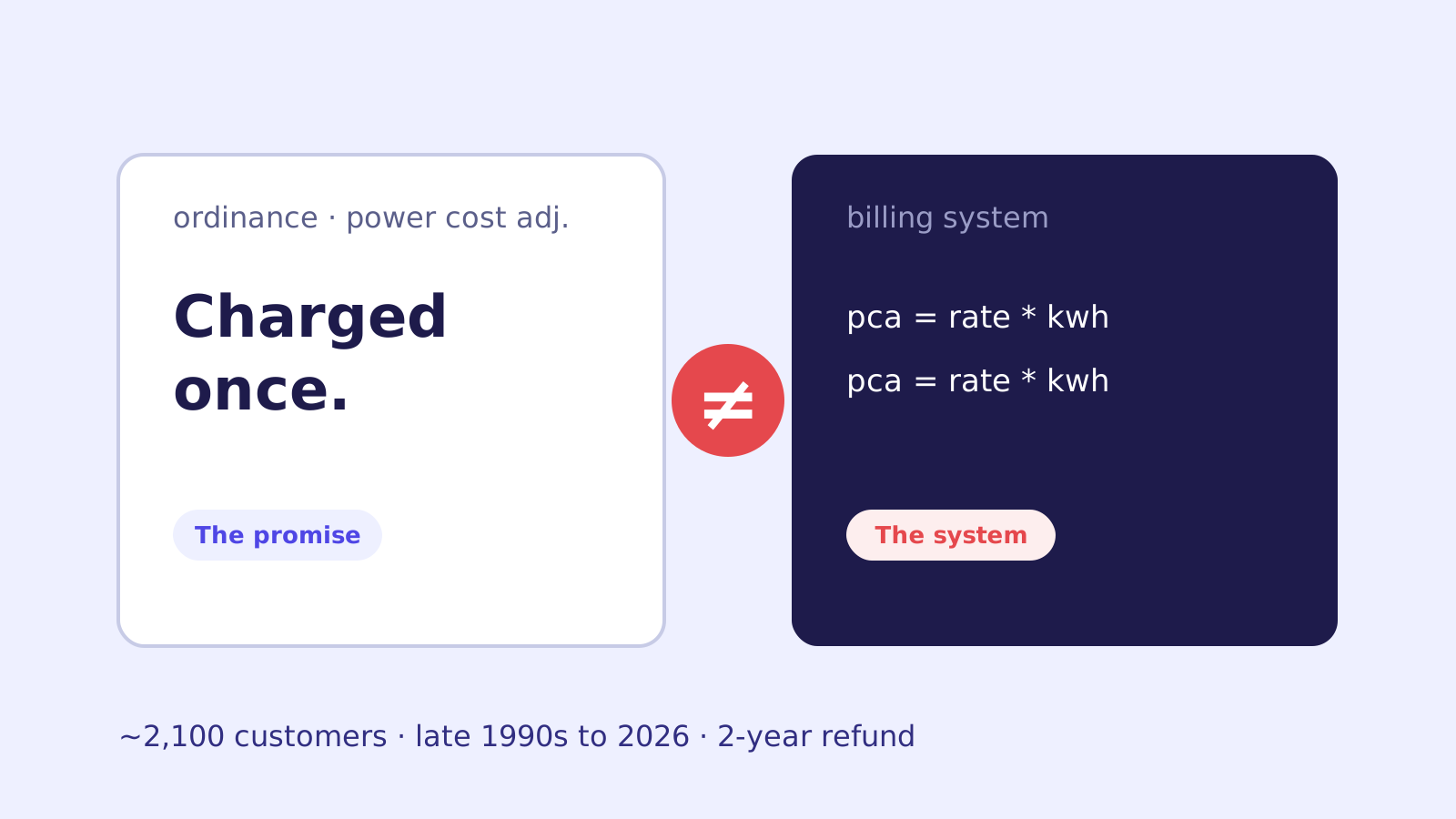
Whitesboro, Texas, supplies electricity to roughly 2,100 customers. In a report published on 30 September 2026, city administrator Phil Harris told local station KXII that a billing error traced back to the late 1990s, when the city’s billing system was first installed. The system applied the Power Cost Adjustment (PCA) rate incorrectly depending on customer type. For residential customers it charged the PCA twice on 30 kilowatts of power. For commercial customers it charged it twice on total usage1.
Nobody inside the city found it. A customer did, after power rates went up. “This looks like this is doubled up,” he told them. “We owe citizens some money,” Harris said1.
How much will customers get back?
Residents expect about $15 each. That is not what was overcharged over three decades. City attorneys say the law requires only a two-year refund, and Harris said the city could not afford to pay back 30 years of mistakes1. The error ran for decades. The refund covers two years.
Why does a rule like this survive so long?
Because it is not a failure anyone can see. The system never crashed. Every bill was produced on time and every customer paid it. The rule did what it was written to do. It simply was not what the ordinance said.
- The people who know the promise (the ordinance, the tariff, the terms) do not read the billing logic.
- The system’s builders wrote the rule once, in the 1990s, and it has run unchanged since.
- Spot checks of a bill pass, because a doubled charge on a small quantity of power looks like a normal charge.
So the gap waits until someone with a pencil and a suspicion looks at their own bill.
What did the city decide to do?
Harris said the city will bring in an outside auditor every year to “look at the calculations, compare it to the ordinance and make sure it’s billing accurately”1. That is the right check. It is also a manual, once-a-year one.
Can the comparison be continuous?
It can. The check the city has promised is to put the written promise next to the rule the system actually runs, and ask the person who owns the rule about every difference.
AppThentic does this comparison. It reads the rule in the system: who it applies to, what it charges and since when. You load the ordinance, terms or rate sheet as a source. The owner is asked the narrow question: “This charge is applied twice. Why?” Where the rule and the promise differ, it is marked Disputed, with both sources side by side, until its owner settles it. When an approved rule later changes in the code, the owner is asked again. See When the system breaks a promise.
Where to start
Take the five charges on your customers’ bills that come from a formula, such as a fee, an adjustment or a surcharge. Find the document that promises each one. Compare what the document says with what the system does for one customer in each segment. The first difference you find is cheaper to fix now than after a customer sends the email.
What is the lesson for a company that is not a city?
The size of the refund was set by the law, not by the size of the mistake. Where the law allows less, the customer pays the difference. Where it does not, the company does, back to the day the rule began. In both cases the only variable you control is how long the gap stays open, and every year it stays open, someone notices later.
Sources
- KXII, Billing glitch overcharged Whitesboro electricity customers for decades (30 September 2026)